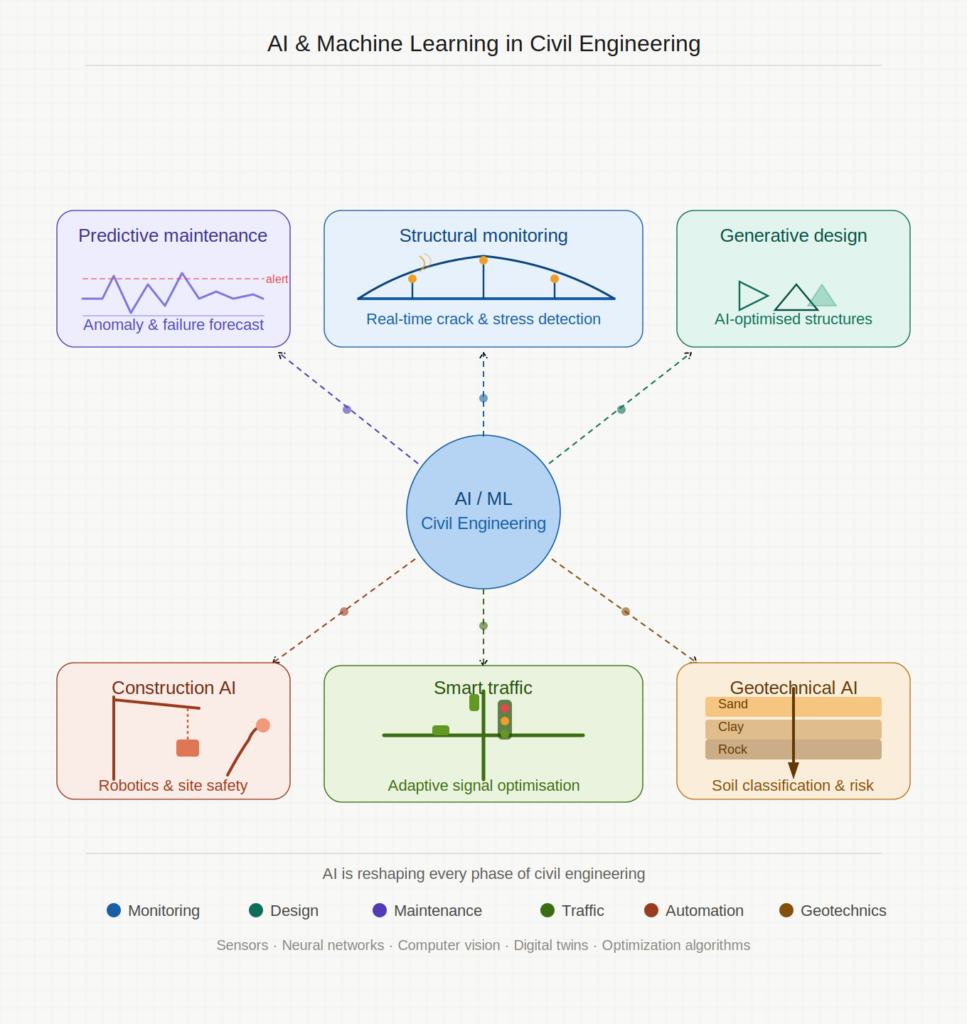
Artificial Intelligence and Machine Learning are revolutionizing Civil Engineering by empowering a shift from traditional, experience-based practices to intelligent, data-driven, and predictive infrastructure systems. In transportation engineering, these technologies are widely applied in smart urban mobility for traffic congestion prediction, adaptive signal control, public transport optimization, and travel demand forecasting using real-time sensor and GPS data. In structural and geotechnical engineering, AI supports structural health monitoring, bridge condition assessment, predictive maintenance, slope stability analysis, soil property estimation, and flood forecasting, allowing engineers to detect risks early, improve safety, and design more resilient infrastructure. In construction management and project delivery, AI enhances efficiency through automated scheduling, cost estimation, risk analysis, and safety monitoring using computer vision and intelligent systems. These advancements improve productivity, reduce human error, and optimize decision-making across the project lifecycle.
Looking forward, the integration of digital twins, IoT-enabled smart cities, autonomous construction technologies, and AI-based sustainability and climate-resilient planning will redefine the future of civil engineering. Overall, Artificial Intelligence and Machine Learning are driving a fundamental transformation toward smarter, safer, and more sustainable infrastructure systems capable of meeting the growing demands of modern society.